
RENT returns to TOHO for its eighth production: What has remained at the heart of the show


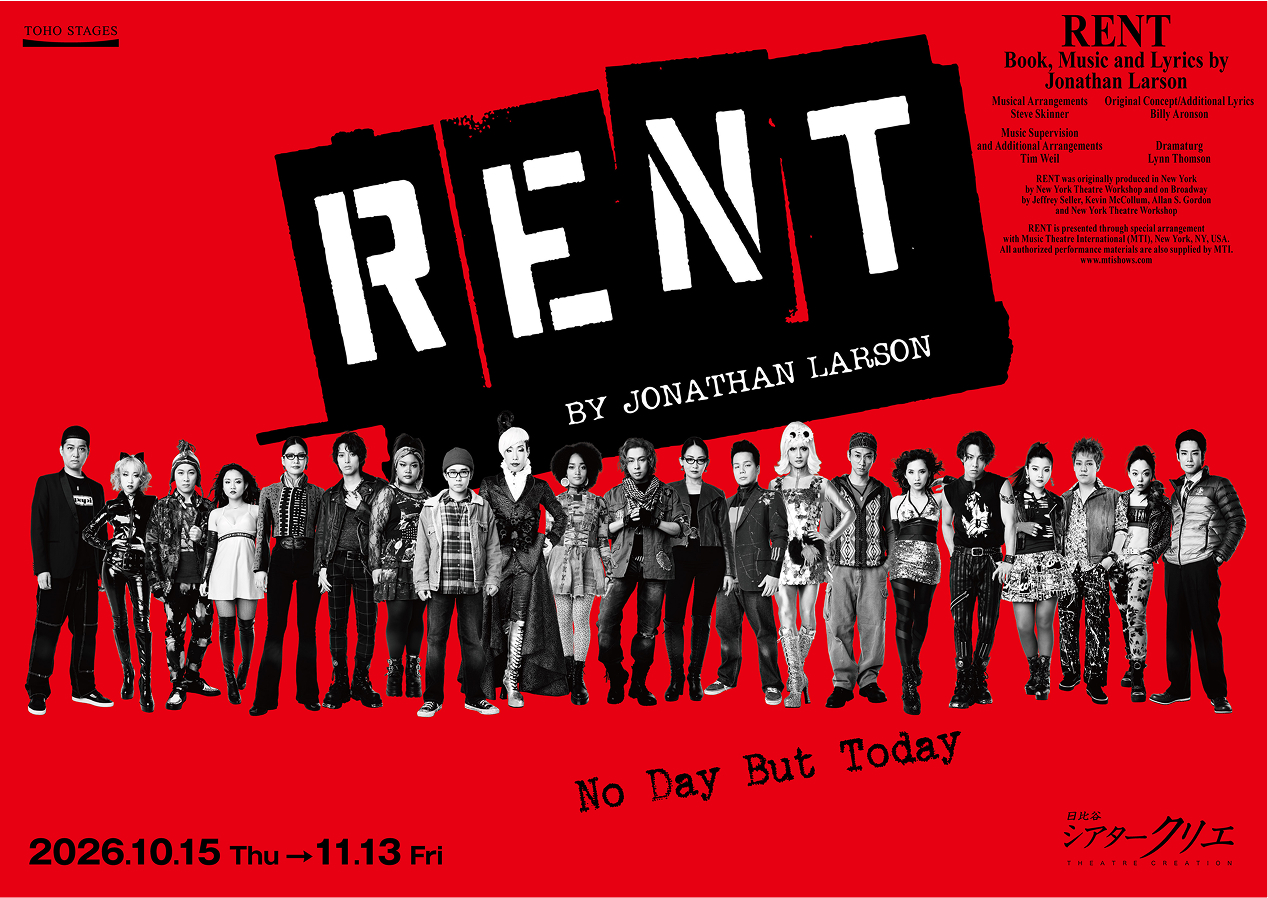
Since its premiere in 1996, the musical RENT has been performed in more than 40 countries around the world. Set against the social realities of its time, the musical follows a group of young people as they navigate the challenges of life, including issues such as AIDS and drug use. Despite the hardships they face, they hold on to their dreams and continue to find hope in love, friendship, and the connections they share.
TOHO first staged RENT at Theatre Creation in 2008, and in October 2026, the production returns for its eighth run. We spoke with Mariko Kojima, who has produced every TOHO production of RENT since its Japanese debut, about what the musical means to her and the principles she has remained committed to throughout its history at TOHO.

“This is our story!”—A musical that still moves me after 100 viewings
How could I do justice to RENT?
Honoring the original message from the very first production
As RENT opened a new chapter for TOHO, I’m taking on new challenges of my own
Looking forward to the unpredictable chemistry of a new cast
“This is our story!”—A musical that still moves me after 100 viewings
――What does RENT mean to you personally?
Actually, I think I’ve seen RENT about 100 times in the United States. (laughs)
The first time I saw it was in 1997. At the time, I simply thought, “Everyone’s talking about it, so I should go see it.” Of course, I thought it was a great musical, but it didn’t really resonate with me on a personal level.
The following year, I moved to New York to study theater at Columbia University’s graduate school. I found myself surrounded by young people who reminded me of the characters in RENT. They had very little money, were taking on debt to pay their tuition, and were devoting themselves to their creative work. When I saw RENT again while spending my days with people like that, I suddenly thought, “This is our story!” I was completely hooked.
For the next seven years or so, there were times when I saw it two or three times a week, so I must have seen it around 100 times in total. Even then, it felt fresh and moving each time. I ended up in tears at every performance.
RENT is an ensemble story about young people. Of course, the story and music are wonderful, but I think one of its greatest strengths is the range of characters it portrays. Almost anyone can find a character whose perspective resonates with their own experience.
While studying theater, I was also fortunate enough to have opportunities to become involved with RENT. I interned at the company that produced the musical, and at the theater where RENT originally premiered, I worked on reading and selecting submitted plays.
That was where I met Anthony Rapp, one of the original cast members of RENT. I even helped him sell his CDs by hand. (laughs) Later, I organized a RENT Gala Concert featuring him and a Japanese cast and brought him to Japan.
I was simply a fan following a musical I loved, but the more I became involved with RENT, the more I found myself connected with the people who had created and performed it.
Looking back now, I think those experiences ultimately led me to the work I do today. But at the time, I never imagined that I would one day become the producer of RENT myself.
How could I do justice to RENT?
――How did you become a producer at TOHO?
When I returned to Japan for summer vacation in 2004, I worked part-time as an interpreter on TOHO’s production of Miss Saigon. Around the same time, TOHO was preparing to launch Theatre Creation and was apparently looking for a young female producer.
At the time, I was working as an interpreter and translator while also getting involved in several musical productions as a dramaturg, working closely with directors and playwrights.
Someone at TOHO who knew about my background asked me, “Would you like to try producing?” That question led me to join the company in 2005.
I had no experience as a producer, of course, so my first year at TOHO was essentially a period of training. I worked backstage, learning the fundamentals of producing firsthand. When Theatre Creation opened in 2007, I began taking on productions as a producer in my own right.
The role of a producer is incredibly wide-ranging. From developing projects and casting to shaping the overall production, you work with everyone involved to determine what you want to create and how to bring that vision to the stage.
There is also a practical side to the job, from managing the budget to overseeing publicity. You have to make the production as strong as possible while also making sure it succeeds as a business. A producer has to keep both of those perspectives in sight.
――And in 2008, you produced TOHO’s first production of RENT.
When I heard that TOHO was going to stage RENT, I asked if I could produce it.
It wasn’t simply because I loved the musical and wanted to be involved. I knew the circumstances in which RENT had been created, and that made me wonder: “Given where RENT came from, should TOHO—a company known for commercial theater—really be the one to stage it? But if TOHO had already acquired the rights, I felt that I had to be the one to take it on.”
RENT is a story about artists pursuing their dreams while pushing back against the commercialization of art. That spirit is rooted not only in the story itself, but also in the way the musical came into being. It first premiered at a theater run by a nonprofit organization, with most of its cast and creative team still unknown at the time.
For TOHO, the challenge was clear: how could we bring RENT to a commercial theater while preserving its rebellious spirit and the raw energy of the young artists who created it?
I believed that taking on that challenge would make the production stronger—and ultimately give audiences a reason to come and experience it for themselves.
――How did you approach that challenge?
We held open auditions with the message, “People who aren’t involved in musical theater are especially welcome.” We wanted to open the door as widely as possible, including to people who had never been part of the musical theater world.
I felt that treating everyone who came to the auditions equally, regardless of whether they were already well known or completely unknown, was one way of showing our respect for RENT.
We also kept asking ourselves, “If Jonathan Larson were staging RENT today, what would he do?” That question became a guiding principle, shaping everything from the costumes to the set.
The set for TOHO’s production was designed by David Korins, who was still relatively unknown at the time. Today, he is one of Broadway’s leading set designers, with credits including hit productions such as Hamilton and Beetlejuice.
The first production ran for more than 70 performances, and almost all of them sold out almost immediately.
We also wanted to reflect RENT’s engagement with the wider society around it. We invited members of the original Broadway cast to Japan and, on a day when there was no regular performance, staged a charity performance together with the Japanese cast. The proceeds were donated to organizations including the Red Cross.

Honoring the original message from the very first production
――As the production has continued over the years, are there things that you feel have changed?
TOHO first staged RENT in 2008, and since 2012 we have presented a new production directed by Michael Greif, who also directed the original production. We have continued to stage it over the years, and this will be our eighth production.
RENT was created in the 1990s, but the struggles of creating art, the pain of losing someone you love, and the message at the heart of the musical—“No Day But Today”—are universal. I think they remain just as relevant today.
At the same time, AIDS, sexuality, and drugs form part of the story’s social context. Over the years that we have continued staging RENT, the medical environment surrounding AIDS has changed, as have society’s attitudes toward sexual minorities.
With each production, we continue to refine both the staging and our publicity so that generations who did not experience that period firsthand can also connect with the work.
Another thing we do with every TOHO production of RENT is hold a series of study sessions at the beginning of rehearsals.
We invite people from support organizations and others to help the entire cast and staff deepen their understanding of life in New York in the 1990s, as well as the situation surrounding AIDS both then and now.
This time, we held around four such sessions, including remote sessions with people in the United States.
――What have you remained committed to since the first production?
Communicating what Jonathan Larson wanted to say through RENT.
Jonathan Larson, who wrote the music, lyrics, and book for RENT, spent seven years creating the musical and died at the age of 35, the day before its first preview performance.
I believe it is my job—and my mission—to share the many messages he put into RENT with as many people as possible, including its central message: “No Day But Today.”
――Is there anything you keep in mind in order to remain faithful to the original?
Whenever we are unsure about something in the production, I try to ask myself, “What would Jonathan Larson do?”
And it isn’t just me. The entire team approaches the production with the same question in mind.
Some of the artists on the team worked with Jonathan on the original production, while others have performed in RENT in the United States.
I believe Japan is the only place in the world where Angela, the original costume designer, still attends rehearsals for every production and revises the designs to suit each cast.
Everyone shares the spirit of RENT and keeps it at the heart of the creative process. I think that may be the greatest commitment behind TOHO’s production of RENT.
As RENT opened a new chapter for TOHO, I’m taking on new challenges of my own
――What do you find exciting about creating musicals at TOHO?
TOHO has built up a wealth of expertise through many years of producing musicals.
Having the solid foundation of TOHO behind me, together with so many colleagues around me, gives me a great sense of reassurance. Knowing that we’ll find a way, whatever happens, gives me the confidence to take on new challenges without being afraid to take risks. That, for me, is what makes creating musicals at TOHO so exciting.
RENT itself is one example of that kind of challenge. We took on a type of production that TOHO had never attempted before, and it went on to become a musical that we have continued to stage over many years. In that sense, I think RENT opened a new door for TOHO musicals.
I also try to keep taking on new challenges in my own work.
Last year, we staged the world’s first musical adaptation of the Korean webtoon Itaewon Class. It was a production in which we took on the challenge of working remotely with creators in Japan, Korea, and the United States to develop the script, music, and other elements together.
As another new initiative at TOHO, we developed the Musical Theater Writing Program to nurture musical theater writers and composers. Since 2024, it has been held annually by the Film and Theatre Culture Association.
There are still very few writers in Japan who specialize in writing musicals, so I hope that nurturing the next generation will lead to the creation of many more original musicals in Japan.
Looking forward to the unpredictable chemistry of a new cast
――What should audiences look forward to in the eighth production of RENT this autumn?
We have made major changes to the cast this time.
As always, we held thorough auditions for every role. Actors with professional experience—including Fuku Suzuki, who plays Mark—also auditioned for their roles.
As with every production, quite a few members of this cast will be making their stage debuts.
One part of the spirit of RENT is that we are willing to cast people with no professional experience if they are right for the role, even if it is their first time on stage.
I attended the auditions myself, and my impression was that we had brought together a very distinctive group of personalities. I’m also looking forward to seeing these unique young performers grow over the course of the production.
I’m a producer, but I’m also a musical fan myself, and with TOHO’s RENT, I can never predict—in the best possible way—what kind of chemistry the cast will create each time. I think I may be the most excited person of all. (laughs)
That chemistry—the sparks that fly when different personalities come together—is one of the greatest appeals of RENT.
For those seeing RENT for the first time, I hope it will open the door to a kind of musical they have never experienced before.
And for those who already know and love RENT, I believe this production will offer both the qualities that have always made it special and something fresh to discover.
I’d love for audiences to come to the theater and experience that energy for themselves—the excitement of seeing something that can only happen in that moment, with that particular cast.
Official website for the musical RENT (in Japanese)