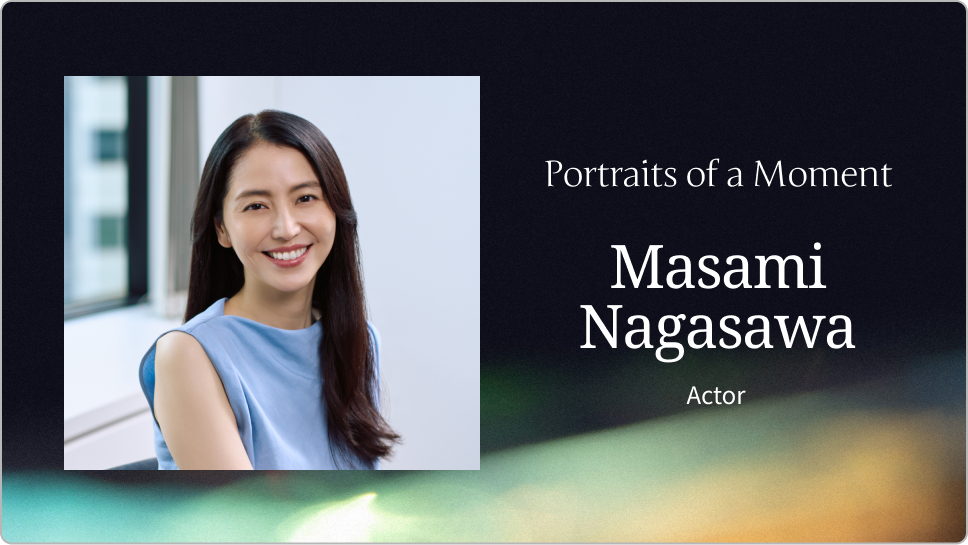
The Joy of Collaborative Art: Masami Nagasawa Reflects on Her Career as an Actor


As a child, Masami Nagasawa was too shy to speak. In the company of strangers, she would hide behind her mother and let her do the talking. Not what you'd expect from the now-celebrated actor who won the TOHO Cinderella audition at age twelve and, that same year, landed her first role in a major film.
A quarter of a century has passed since then, and things have changed. Nagasawa has starred in hit films, television dramas, and stage productions, one after another. She has earned her accolades, and her presence in the entertainment world is unmistakable and bright.
Throughout her career, though, she has had her share of struggle. What separates now from then is that she has learned to turn all of it into a source of strength.
We sat down with Nagasawa to learn about the unique brand of sincerity she brings to her work as an actor, and to hear her thoughts on the power of entertainment today.
A shy nature, a need to perform
――When you first made your debut, how did you think about acting as a profession?
I was thirteen at the time, so honestly I don't remember it very well. But I went back and watched the interview footage from when I won the grand prize at the TOHO Cinderella audition. When they asked how I felt about appearing in a film so soon after my debut, I answered, very clearly, “I'm so happy. I'll do my best!”
I was actually surprised by how decisive I sounded. I think, even back then, I must have had a strong sense that acting was something I wanted to take seriously.
――Where did your interest in acting come from?
Ever since I was a child I loved TV dramas. If there was a show I really liked, I'd watch it every week.
I also still have a very vivid memory of a theater troupe coming to my elementary school to put on a play right in front of us. There was a scene, a bit of stagecraft, where it looked like people were jumping right out of a screen. It had a strong effect on me, and I remember sitting there watching them, completely fascinated, wondering, “How on earth did they do that?”
At the same time, despite that fascination, I was so shy about speaking in front of people that I'd often hide behind my mother. I’d let her do the talking for me.
But I was so drawn to the idea of expressing something; I just had no confidence I could actually do it myself. Those two opposite feelings stayed with me for a long time.

The art of picturing yourself, and a new frustration
――Your talent as an actor was apparent from a very young age.
I don't think this is true only of acting, but figuring out how to handle yourself is really tough, isn't it? It feels a little strange to say this about myself, but I'm serious by nature. I can't move forward unless I understand things in a certain order. Once something makes sense to me logically, I can take the next step.
I'm also the type of person who moves toward whatever ideal, or whatever version of myself, I've already imagined in my head. Even when I did my first stage play, I was able to make myself do it because I had already pictured myself standing up there. It's the same with other work: if I can picture myself doing it, I give it a go. I think it's the piling-up of those attempts, one on the next, that has built my life as an actor.
But acting is a job where the roles you play keep changing as you get older. The ideal I pictured, my actual ability at the time, the path I was choosing: in my early twenties those three didn't always mesh, and the frustration of it all…it really wore on me for a long time.
When times are tough, Mother steps in
――The early twenties are when a lot of people worry about their direction and their work. How did you get over that wall?
For me too, that stretch was, in a way, my own version of job-hunting. But I was lucky too; I'd found what I wanted to do early, and the people around me were supportive. But once you start asking, “What does work even mean to me?” all sorts of worries and doubts come up.
What helped me was the fans, knowing that there were people who wanted to see me act.
And then something my mother said to me: “If you work as hard as you can, the work won't betray you.” It made me realize that as long as I put care and effort into my work, it would eventually come back to me in some form. But the way it would come back to me was beyond my control, so really the only thing I could do was keep going. That’s how I made it through a really tough time.
――Was that when you began to establish a kind of philosophy for yourself?
A seasoned actor once told me, “Eighty percent of an actor's work is luck.” I agree with that completely but, at the same time, I have a sense that luck is also something you cultivate yourself.
How much sincerity can you bring to the work in front of you? How much can you believe in yourself? If you approach your work with integrity and honesty, and really take your work seriously, rather than putting on a “nice person” act just to be liked, there will always be someone who sees it.
I think if you keep working on yourself in that way, the scale of your luck, and your connections with other people, both start to move in a better direction.

What it means to compete with yourself
――A real professionalism comes through in the details of how you talk about your work. On a set where so many professionals come together, what do you find most compelling about the creative process?
Every film, television drama, and stage production has its own color, its own air. There's a chemistry that happens only because of those particular people, things that could only be done with that team. Everyone brings their own expertise, and together we build a single work. That's the wonderful thing about a collaborative art form.
Even when I’m confronted with a different way of doing things, something that might not fit within my usual set of rules, I try to trust the other person and accept it. That's where new discoveries come from.
――Does each project feel like a new test of what you can do as an actor?
I approach each and every project with care, but I don't think of acting itself as “a contest against someone, against something.” People around us love to pit actors against each other (laughs), but it isn't a job about deciding who's number one.
That's why the fans who cheer me on mean so much to me. I imagine what the people who've watched me all this time might want to see; I think, “What kind of role would they like to see me play next?” And then I try taking on a role I've never done before. For me, maybe that's where the real competition is, in its own way.
No two works are ever the same. That's what makes creating something so interesting. My goal is to deliver a one-of-a-kind work that the people watching are glad to see and go on loving for a long time, not to make something more impressive than anyone else's. That’s the attitude I try to bring to my work. Really, I'm just giving it everything I have.

The bustle, the love of film: remembering TOHO studios before renovation
――You've been close to TOHO's productions since your debut. Is there a particular memory of TOHO studios that has stayed with you?
I have especially fond memories of the studio before it was rebuilt. It's gone now, but back then there was a big communal bath. A veteran lighting technician used to soak in it every single day; I was told it had practically become his own private tub (laughs). I also remember the delicious tanmen noodles at the cafeteria. Looking back now, some of the heat and energy of Shōwa-era filmmaking, when sets were packed with people, was still lingering there.
But what really made that place special was there were so many people who genuinely loved film. As a child I remember thinking, "A studio is like a bustling little town.” I loved it so much that even mid-shoot I'd think, "I want to stay here forever."

Entertainment gives us the energy to enjoy life
――You've spent a long time inside the world of entertainment. For you, what is its appeal?
I think entertainment gives our lives meaning, culture, richness. When you watch an old film, you get to know the stories, the daily life of an era, and the daily life of its people, all from another time that's already gone.
There are probably things that would be easy to do with AI now, but people back then spent an enormous amount of time and effort finding ways to express their artistic vision. Just seeing a scene like that, seeing how it all came together, can be incredibly inspiring.
I also find it fascinating how a film itself becomes a kind of “language.” In a happy moment with your friends, for example, you can sum it up with a single title, “It's just like that movie.” And with that one reference, you share the whole scene, a whole set of images and feelings, with someone else.
Every time I find a new work of art, it feels like I’ve added another drawer to myself. I can open that drawer at any time, and it adds a new layer of depth to the way I think, the way I experience the world. Each work of art has so much energy packed into it.
――As an actor, what kind of future do you imagine for yourself?
I remember something someone once said to me: “There’s no retirement age for actors.” As you get older, you find roles you can only play at that age, and you get to keep enjoying the work yourself. I really do feel it's a wonderful profession.
The more entertainment you find, and the more you grow to love, the more you begin to understand how you want to enjoy your own life. You start to see how to live in a way that keeps you joyous.
Entertainment gives you that special kind of energy, and I think it’s one of the greatest things about it. I’ve received that energy from so many powerful works of art over the years. And so now, as an actor, I hope I can pass that joy and that richness on to people of every generation.